
Ruptured
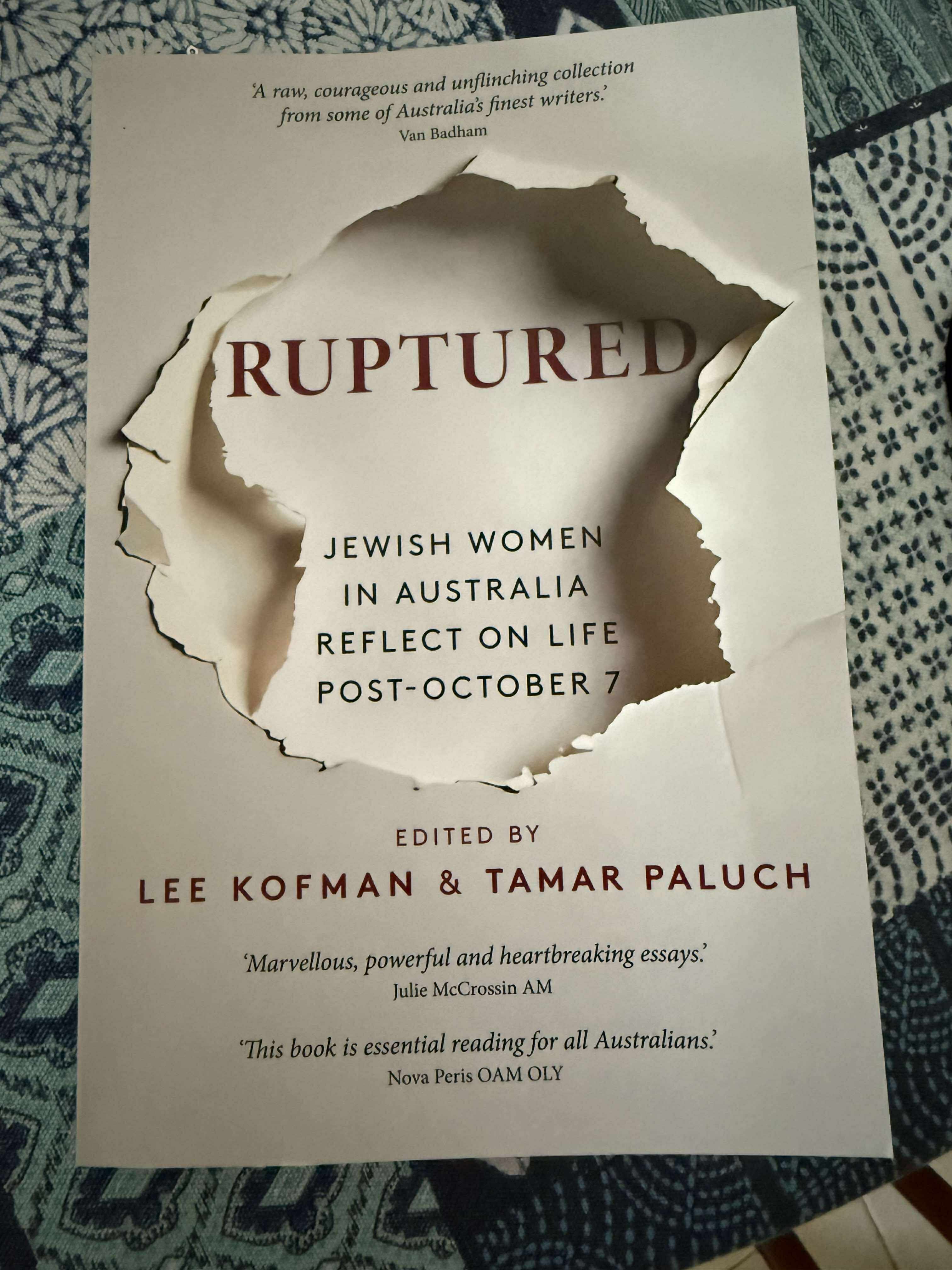
Part 2 of my Jewish story, and a review of the book edited by Lee Kofman and Tamar Paluch

On October 7, 2023, I texted Nikki, ‘Is your family okay?’
I knew Nikki had family in Israel, cousins her own age, and their children, who would have been about the age of the young, largely left-wing Nova outdoor music festival goers who were celebrating the Jewish holiday.
One of Nikki’s female cousins was missing. Her family were watching in horror as the news of the massacres of 1,200 Israelis and 79 others, mainly Thai workers, came through, alongside news of the 240 hostages.
I remember thinking how unusual it was to see news reports that were sympathetic to Israel. I also remember thinking that the response of Israel was going to be brutal - anyone who had paid the slightest attention to Netanyahu would have known that. Yahya Sinwar would have known that.
I was relieved when Nikki texted, some days later, that her cousin was located and was okay, and then, apart from watching the news with concern, I didn’t think much more about it.
Later in October, I visited Nikki’s to play music. As we sat down to our pre-playing cup of tea, I saw her eyes were red, and she looked haunted.
‘Are you okay?’ I asked.
She was not okay.
She told me how deeply shocking and frightening the sheer brutality of October 7 had been for a community with such a history of intergenerational trauma.
She told me that there had been a deafening silence among her friends about what had happened on October 7. She was not only upset about the silence: some of these 'friends' were also posting anti-Zionist content constantly, making ill-informed statements about Israel, and yet were silent about Hamas’ actions. If she tried to correct the misinformation, they would just argue with her. And not one of them asked if she was okay, or her family was. It did not even occur to them. It was bewildering for her.
She told me about how already people on social media were ‘West-splaining’ how Israel brought the massacre on itself. How the protests, which had already begun even before Israel had responded to the massacre, felt like echoes of the 1930s in Germany or Poland.
And how none of the feminist organisations she’d supported for decades had spoken out against the particularly horrendous sexual violence Hamas perpetrated on Israeli girls and women.
‘That can’t be right,’ I said.
‘Go check it out for yourself,’ she said.
And I did. And then began a painful process of re-evaluating what I thought I knew.
*
Part of the re-evaluation involved a painful reflection: if I did not know Nikki, her family and her family’s story, or have the experiences I’ve had with Jewish hospitality, with Jewish writers, or have read so much about the history of the Middle East (though I hasten to add that I am far from an expert) - if I had not informed by all that, I may well have been one of the people unwittingly inflicting race-based trauma on people in my community. Not on people in a war on the other side of the world: on people in my community. The arts community. The community with which I had always felt aligned, and which I felt was my home.
Many individuals and organisations called on writers and artists to speak out for Palestine and condemn Israel. But I soon learned that nobody making those calls wanted nuance. Few people wanted dialogue. Even fewer wanted to hear that they were not informed about the arguments that they suddenly were embroiled in.
I lost a friend I’d had since I was 16, who refused to believe we had anything in common when I tried to explain what the River to the Sea slogan actually meant. I was doxxed by people who refused my pleas to meet and discuss my position on Israel/Palestine (as if my position mattered to anyone, let alone Hamas and the Netanyahu government). I had to threaten legal action.
But this was nothing compared to what Nikki experienced.
*
Now, finally, there is a book that reflects Nikki’s experiences, and the experiences of other Jewish people in the arts community I’ve spoken to. When I have tried to raise the issue of antisemitism here in Australia, and its damaging effects, and how words matter - something that I’ve tried to do more in person because I quickly learned that doing it online would never work (see above) - I would either be met with ‘what-about-ism’ or polite nodding.*
This book - whose contributors come from a range of backgrounds and views - more powerfully shows what the response of the Australian left, arts, and queer communities in particular has meant for Jewish women. It shows the effect of the weekly rallies and increase in attacks on Jewish businesses and the aggression toward Jewish people online on Australian Jewish women and their families.
‘When people left hateful comments on my feed, I knew I hadn’t imagined what I had been feeling - a slice of history repeating, echoes from a storied past vividly present.’
‘Something else starts happening. We see protests in the news. Well, not protests so much as celebrations. Celebrations of the death of my family.’
‘Nothing much counts as antisemitism anymore for my friends on the left. Suddenly, everyone who has never thought about antisemitism knows how to say, stop weaponising antisemitism, Everyone is talking about how many friends they have who are Jews (look at this great bunch of Jews at the protests!) and how much they love Jews who hate the idea of Jews having their own homelands.’
‘Politicians pose next to posters with defaced Stars of David. None of this (we Jews need to understand) is antisemitism.’
‘I talk to a health insurance broker who says the number of claims emerging from serious diagnoses amongst his Jewish clientele is unprecedented.’
‘There are two peoples who are indigenous to the land of Israel. This is the source of the conflict.' … The first comments were fast to arrive, the likes of ZIONISTS LOVE GENOCIDE.’
‘The haters decoupled my very few words (seven to be exact) from the context of their intent, waving them as a flag to proclaim by disregard of human suffering. The meaning of my words in context is: Hamas’ use of underage boys as fighters and then as part of the childhood casualty count is a horrendous, cynical exploitation of young lives.’
More than a few writers - authors of thoughtful, nuanced books, people known for their compassion, rushed in to take sides in an ancient, endlessly complex conflict that even I, someone who spent her youth in Israel and has written books in its language, cannot properly grasp.’
‘When I refused to throw myself headfirst into the rapidly swelling tide, rising seemingly out of nowhere at bewildering speed, I was dropped and denounced and smeared.’
‘Sometimes we [the writer’s Palestinian friend and herself] compare our social media feeds and are shocked at how different they are. We see how misinformation is being weaponised to drive people further apart ..'.’
There are so many examples about what has been wrong with the whole narrative since October 7 I could include them in another 5 posts without difficulty.
Instead, I urge you to buy, read, share this book.
If people think that it is okay that they experience this because Jews are a minority, would it also be okay for any other group to be subjected to hostility, threats, physical attacks, and denial of their experience because of their race, culture, or religion? If it’s not - why is it all right for Jews to experience this in this country?
And if we can’t agree or act with civility over differing views here, where most of us live in safety, what hope is there for peace in the Middle East, where conflict has gone back centuries?
Thank you for reading and subscribing. I urge to to buy a copy of Ruptured. To read it, think about it, let the perspectives it contains sink in. Please.
*Let me be clear, again: I abhor what the Netanyahu government has done and is doing in Gaza. I actively support Standing Together through donations and through promoting what they do on the ground in Israel and Gaza. I have no idea how peace will be achieved, only that it the current situation cannot go on. I detest Hamas and the Islamic brotherhood extremism that it represents.
You show great moral courage in sharing an unpopular opinion Julia-I too have a great resonance with Judaism, because it was learning about the holocaust that started me questioning racism in general, plus we were religious nuts, and we knew that our poster boy was Jewish. I was raised really racist, but funnily enough, we weren't anti-Semitic, and the notion was quite baffling to me. I'm still climbing out of the dark web of racism and have to stay alert all the time, as it was like a mental disease planted in my brain. The idea of hurting or insulting Jews makes me feel sick, yet I can see that Netanyahu is behaving like Hitler, and it's hard for me to see nuance in the current situation. It would also be hard for me to join a march for Palestine though, because I could never be sure that I wasn't standing with someone who hates Jews per se. I think the real problem is power, money, greed and intolerance and those things can't be fixed by maintaining hard, uncompromising positions. We have to be able to see ourselves in the suffering of others. When I was a child, I shuddered at the thought of being one of those people in the cattle trucks. Now, I look at my granddaughter and shudder to think of her having an amputation without anaesthetic in Gaza. To discount and minimise anyone's suffering is to perpetuate the consciousness that allowed the suffering to happen. It's very bleak, but we must continue to strive to reach each other! Thanks for your thoughts x
I would like to add another perspective: Nothing happens in a vacuum.
I encourage everyone here to also read,
The Hundred Years War on Palestine a History of Settler Colonialism and Resistance, 1917-2017
by Rashid Khalidi. Recommended to me by the creators of Mondoweiss.
Being forced from your generational homes into a camp, all your possessions taken from you, your homes destroyed, rights taken away....sounds pretty familiar to me.
I believe Jules knows I am not anti-semitic, hell, I found out I was a "Shiksa" from both of my jewish boyfriends in Sydney. Coming from the states, I had only heard the term once - a friend's father announced at breakfast that, "Shiksas make the best Jewish mothers!" But at the time, I did not take it as an insult. Live and learn.
And, being that I am in the HELL- HOLE (sorry for the all caps) that is the US at this time, People are being arrested, kicked out of schools, universities are losing their funding, being out in interment camps, etc.... if there is any pro-Palestinian speech.
The destruction and takeover of Gaza is Netanyahu's wet dream come to life...and the Orange Stain is gleefully helping him.
The world is on fire.
Love ya, Jules.